Scale Content With AI: How to Keep Your Authentic Voice
As AI tools become essential in marketing, brands face the challenge of scaling content production without losing their unique human touch. This article explores actionable strategies for treating AI as a co-pilot rather than an autonomous author, ensuring your output remains genuine and trustworthy. You will learn how to define your brand voice, inject real experiences, and seamlessly blend automation with authenticity.

To scale content with AI while maintaining an authentic voice, treat AI as a co-pilot, train it on a strict voice contract, and always inject real human stories.
As artificial intelligence tools become essential in modern marketing, brands face the challenge of scaling content production without losing their unique human touch. Relying purely on automation can erode the very trust that builds long-term audience loyalty. This article explores actionable strategies for blending automation with authenticity. You will learn how to define your brand voice, inject lived experiences, and keep human creativity at the helm of your strategy.

Why Does AI Content Often Feel Generic?
AI content feels generic because language models predict the most mathematically average next word, inherently stripping away the unique quirks that make writing sound authentically human.
When you prioritize pure volume over quality, you risk publishing robotic, uninspired content. Brands that treat AI as a complete replacement for human subject matter expertise often end up sounding exactly like their competitors. Instead, you must treat AI as a creative assistant or co-pilot, leveraging it to overcome writer's block rather than handing over the entire creative process.
According to a recent report by Forbes Advisor on AI trends, brands investing in AI content tools see a 420% ROI, 62% faster production, and 32% higher engagement. However, these massive returns are only achievable when human oversight prevents the final output from sounding hollow. Preserving long-term reader trust means always prioritizing content quality over sheer quantity.
How Can You Train AI on Your Specific Brand Voice?
You can train AI on your specific brand voice by developing a precise "voice contract" that dictates your exact tone, vocabulary, and audience preferences.
A voice contract is a comprehensive prompt or source document you feed into your AI model before generating any content. This document should outline exactly what your brand sounds like, what buzzwords you intentionally avoid, and the specific sentiment you want to evoke. Without this critical guardrail in place, the AI will simply default to its standard, overly enthusiastic corporate tone that readers immediately recognize as artificial.
What Should You Include in a Voice Contract?
You should include audience descriptions, approved terminology, and formatting guidelines in your voice contract. Consider adding the following specific elements to improve your AI output:
- ✓Detailed descriptions of your target audience's specific pain points and daily desires.
- ✓Lists of approved industry terminology alongside strict lists of jargon to avoid.
- ✓Direct examples of your highest-performing historical content to serve as structural templates.
- ✓Specific guidelines on sentence length, paragraph formatting, and overall emotional tone.
Why Is It Essential to Inject Human Stories Into AI Content?
Injecting human stories is essential because AI models cannot organically invent lived experiences, unique anecdotes, or authentic customer emotions.
Generative AI is fantastic at structuring information and summarizing data, but it ultimately lacks a soul. It has never faced a late-night business challenge, celebrated a hard-fought team win, or spoken directly with a frustrated customer. If you want your audience to deeply connect with your brand, you have to bring those real-world, human experiences to the table yourself.
You can confidently draft an article's framework using AI, but you must manually insert real customer stories and unique insights. A study featured in HubSpot's State of Marketing Report indicates that marketing teams utilizing AI experience a 55% reduction in content revision cycles before publication. This saved time should be immediately reinvested into adding those critical, humanizing details that build lasting credibility.

What Is a Safe Workflow for Scaling Content With AI?
A safe workflow for scaling content with AI involves intentional ideation, AI-assisted drafting, human-in-the-loop editing, and rigorous fact-checking before any publication occurs.
AI should do the heavy lifting of staring at a blank page, but a human must always have the final say. Implementing a robust human-in-the-loop review process is absolutely non-negotiable. Editors must diligently verify facts, edit out generic AI transitional phrases, and ensure the brand's credibility remains completely intact.
Industry adoption is happening at breakneck speed. Data from Gartner's research on generative AI highlights that roughly 75% of marketers are currently using or planning to use generative AI for their content creation tasks. To be in the successful majority that scales safely, follow this proven step-by-step process:
- ✓Brainstorm foundational topics based on real customer questions and organic search intent.
- ✓Provide your chosen AI co-pilot with a detailed context prompt and your voice contract.
- ✓Generate a rough draft to quickly establish structure and basic talking points.
- ✓Manually inject your unique subject matter expertise, strong opinions, and customer anecdotes.
- ✓Review and refine the final piece to guarantee it perfectly aligns with your brand standards.
How Can Lumafly Help You Scale Authentic Video Ads?
Lumafly helps you scale authentic video ads by combining powerful AI generation capabilities with intuitive editing tools that let your true brand personality shine through.
Just as written content requires a human touch, video marketing needs your unique voice to stop the scroll. According to a recent Wyzowl study, 91% of businesses now use video as a primary marketing tool. Lumafly makes it effortless for small businesses to produce high-quality, engaging video ads at scale without ever sacrificing their authenticity.
Treat our platform as your dedicated creative co-pilot, allowing the AI to seamlessly guide the visuals while you supply the core vision. Start creating authentic, conversion-driving video ads with Lumafly today and watch your small business sustainably grow.
Frequently Asked Questions
Related Articles
All Articles
How AI Video Ads Drive Real Estate Listings in 2026
Discover how top real estate agents are leveraging AI video ads to dominate their local markets and secure more listings in 2026. This article explores the strategies, tools, and data-driven results behind automated video marketing, showing you how to turn static property links into high-converting campaigns. Learn how to cut production costs while generating high-quality buyer and seller leads at scale.
Read Article
Why AI Video Ads Are Your Competitors' Secret Weapon
AI is fundamentally changing the economics and production speed of video advertising in 2026. This article explores how competing brands use AI video tools to slash production costs, scale A/B testing, and deliver personalized campaigns at unprecedented speeds. Learn how early adopters are balancing automated volume with human creativity to gain a significant market advantage.
Read Article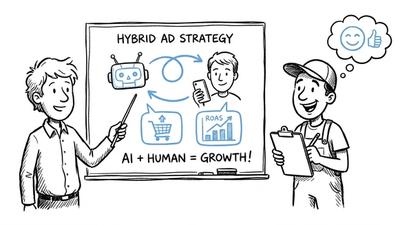
AI Video Ads vs UGC Creators: Maximizing ROAS in 2026
In 2026, small ecommerce brands face a critical choice between the rapid scalability of AI video ads and the authentic trust of UGC creators to maximize Return on Ad Spend (ROAS). This article breaks down the latest performance benchmarks, comparing production costs, click-through rates, and conversion efficiency. It ultimately reveals how to implement a high-performing hybrid strategy that leverages AI for rapid creative testing and human creators for scaling winning ad concepts.
Read Article
AI Ads vs Agencies: Why Small Businesses Are Switching
Small businesses are increasingly dropping expensive marketing agency retainers in favor of AI-powered advertising tools. This shift allows founders to drastically reduce overhead costs while maintaining high-quality ad creatives and data-driven targeting. By bringing AI ads in-house, SMBs gain faster execution, round-the-clock optimization, and full control over their marketing campaigns.
Read Article100% free · No account required
Try our free marketing tools
Spam checker, UTM builder, script timer, caption counters, and SEO previews. Handy while you plan your next campaign.
Ready to create?